The Trinidadian Cooking Terms No Recipe Will Teach You
There’s a moment in every serious Trinbagonian cook’s journey when the words catch up with the hands. You’ve been watching. You’ve been tasting. You’ve been standing at the elbow of someone who has been doing this for forty years. And then they say: “Chunkay it” or “You need to boonjay that first”. That’s when you understand that what you’re being taught isn’t just a step in a recipe. It’s a system of knowledge with its own language.
I’ve been documenting Trinidadian cooking vocabulary and terms since 2006, and the following three terms are the ones I return to most often when someone wants to understand why our cuisine does what it does.
Chunkay.
Boonjay.
Browning.
Chunkay: The Opening Step
Chunkaying is where everything starts. Whole spices, powdered blends, garlic, and herbs go into hot oil and bloom — cracking, sizzling, releasing their essential oils into the fat. This is the foundational flavour base. Everything that comes after is cooked in what the chunkay built. It isn’t a finishing flourish; it is the opening of the dish. The sound matters. The sequence matters. Get this wrong and what follows has no foundation.
Boonjay: The Step That Follows
Boonjaying is often what happens next. Seasoned meat is added directly to the chunkayed pot and cooked down. First covered, then uncovered until all the liquid has cooked off and the ingredients are frying gently in the concentrated aromatics. The pot is dry and the meat has taken on a deep, rich colour, the juices and spices fully absorbed. You can serve it exactly as it is, or add water or coconut milk to build an additional curry or gravy. That decision is yours. But the boonjaying must happen first. There is no shortcut to a dry pot.
Browning: A Heritage Flavour
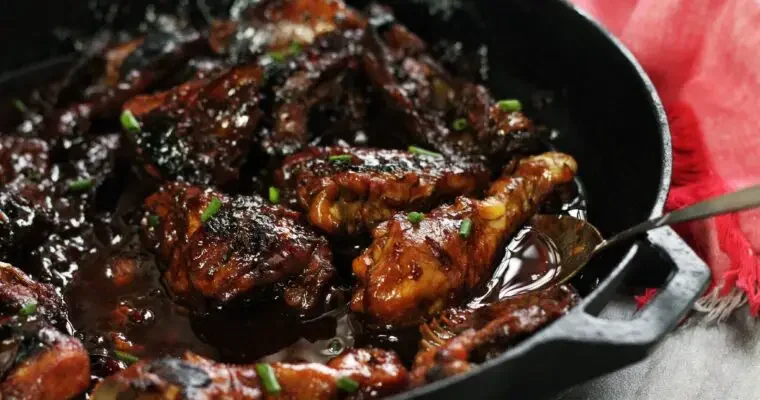
Browning, in the Trinidadian sense, refers specifically to caramelised sugar used as a base for stewing meats, particularly chicken and beef. Sugar (I prefer to use brown) goes into hot oil and is cooked, carefully and actively, until it turns a deep amber and smells almost bitter. The meat goes in at precisely the right moment. Too soon and the dish will be too sweet, the meat too pale. Too late and the caramel permanently seizes and burns. This technique is the backbone of many heritage dishes including Trinidadian stew chicken, and it cannot be substituted with soy sauce or bottled browning without consequence.
Why Trinidadian Cooking Terms Matter
Our Trinidadian cooking terms aren’t decorative. They aren’t “slang”. They are instructions. They are precise, technical, culturally specific. They carry the fingerprints of the African, Indian, European, Chinese, Middle Eastern and Indigenous traditions that collided and combined in Trinidad’s kitchen over centuries.
They’re architecture, the foundational logic that separates a recipe approximation from “the real thing”.
When you learn them properly, you stop being someone who is making a Trinidadian dish. You start actually cooking one.
They’re why I’ve been making the case, over the last nearly twenty years, that Caribbean cuisine deserves to be understood on its own terms.
Most recently, earlier this month, a “shortcut recipe” for doubles, published in the Washington Post, led me to take this argument to LinkedIn.
I laid bare that you can’t shortcut your way to fluency in a language you’ve never learned. And you certainly can’t “improve” on or “shortcut” what you don’t yet understand. However, you can still profit from it, if you are speaking to an audience that is still largely unaware of the errors that were made.
The conversation it opened
When that piece went live, people started reaching out who weren’t only home cooks or food enthusiasts. They were tourism strategists, hospitality professionals, and cultural economists from Trinidad, from across the region, and throughout the diaspora. What they named was considerably bigger than the recipe itself.
Carla Cupid, a tourism strategist in Trinidad and Tobago, framed what was at stake from a destination branding perspective:
“Our cuisine is one of our strongest competitive advantages and deserves greater investment and global positioning… When our cuisine is properly represented, it strengthens destination branding, supports local entrepreneurs and creates deeper cultural connections for visitors. Our voices must play a central role in telling our culinary stories.”
From Antigua, Nicole Antonio-Gadsdon — who works on the people and culture side of luxury hospitality — described what the article opened up:
“There’s so much food for thought about cultural legitimacy, power and authenticity via the lens of Caribbean food. For those of us in the people and culture side of hospitality, especially in the luxury niche, the brainpokes in each sentence resonate — the dangers and the opportunities are clear.”
And from far-flung Belgium, Deborah Wehrens, founder of the culinary IP brokerage Culius, named the structural argument most precisely:
“The authorship gap is the real problem. What the Washington Post incident exposed is not just disrespect. It is a structural failure to recognise that Caribbean culinary knowledge has authors. Specific, named, documented authors. People who spent decades earning the right to say what doubles is and what it is not. When a publication bypasses those authors and reaches for a convenient shortcut version, they are not just being culturally careless. They are commercially erasing the people who built the thing they are profiting from.”
Commercial erasure. That phrase has stayed with me. It names what I’ve been circling for nearly twenty years without quite having those words for it.
Our culinary vocabulary isn’t just cultural inheritance. It’s the foundational block of intellectual property. It’s not just heritage, it’s currency, and it belongs to the people who practice it daily, who document it, who refine it. It deserves more than a convenient approximation by someone who never bothered to learn the words of a song they presumed themselves fit to teach others.

Conclusion
Chunkaying.
Boonjaying.
Browning.
These aren’t just cooking terms. They’re a claim. A claim that our cuisine has a structure, a lineage, and a body of knowledge that was built by specific people over centuries, and it belongs to them. When you learn them. When you use them. You are honoring their legacy.
What the response to my LinkedIn article made clear is that this argument resonates well beyond the kitchen. Tourism strategists are seeing it in destination branding. Luxury hospitality professionals are mapping it onto cultural legitimacy and the visitor experience. Food strategists in Europe are naming it commercial erasure. The vocabulary of Trinidadian cooking isn’t a niche concern. It’s part of a larger conversation about who profits from culture, who gets credited for it, and who gets to define it.
I think sometimes about the woman who asked me the question that started TriniGourmet. An American chef, formally trained, who had never encountered a Trinidadian swizzle stick and stopped cold when she saw one. She asked me questions nobody had asked me before. And I realised, in that moment, that what we had was unique, inimitable, and deserving of correct documentation.
That was 2006 and I’m still at it.
After nearly twenty years, a New York Times “essential guide” designation, and appearances in international media, such as Travel Channel’s Delicious Destinations, the single thing I’m most certain of now is this: when a cuisine loses its sovereign terminology, it becomes available to anyone who wants to repackage it.
The defence isn’t gatekeeping (the knee jerk reaction I see permeating social media).
It’s linguistic precision.
It’s branding.
It’s marketing.
It’s fostering a culture that understands the importance of registering (and respecting) Intellectual Property.
It’s frameworks for visibility, on our terms, that focus less on accessibility and insist instead on 1) why our vocabulary and techniques are ours, 2) why they matter and 3) lead from there.
It’s a willingness to speak up and call out institutional disrespect and not accept “visibility” as a consolation prize.
The terms in this post are ones I’ve been making the case for across nearly two decades in print, on television, in live cooking sessions with food creators across Canada, the UK, and the US. They’re not the whole vocabulary but they’re an entry point, and they build authority.
Start with the vocabulary.
The food will follow.
If what you’ve read here resonates and you’re ready to go further — in the kitchen, in your business, or in how you understand what intentional, culturally grounded living actually looks like — I’d love for us to work together. Explore the ways we can.