
Trinidadian Browning Sugar Technique

The recipe wasn’t wrong. That’s the frustrating part.
You marinated the chicken overnight. You used fresh thyme and charon beni. You followed every step, let the rice absorb at the right heat, and still, when you lifted the lid, something was missing. Not wrong exactly. Just not right. Not the pelau you grew up eating.
Here’s what I want to tell you: the recipe was never the problem. The problem is a technique that most recipes name in a single line, without explanation, without context, and without telling you why it’s the foundation that everything else depends on.
That technique is “browning” the sugar. It sounds simple. It isn’t.
If nobody ever taught you what browning the sugar actually means, what it looks like at the right stage, what it’s doing to your dish at a level no shortcut can replicate, then your pelau will always be missing something you can’t name. This is what I’m here to explain.
What pelau actually is
Pelau isn’t a simple one-pot dish. It’s arguably the most complete expression of what Trinidadian cooking does: takes ingredients from multiple culinary lineages and creates something that belongs entirely to the island.
The pigeon peas carry African roots. The seasoning base, green seasoning worked into the meat the night before, comes from the Creole kitchen that emerged from cultural collision. And the browning of the sugar? That African technique is older than most people realise, and it runs deeper than colour.
At TriniGourmet, I use a name for this: The Croisee™. You may know it as a place, a junction, a crossroads. That’s exactly what I mean by it here. The Croisee™ is the point where every culinary tradition that arrived in Trinidad met, collided, and built something no single tradition produced on its own. It isn’t a metaphor for influence. It’s a description of what actually happened in our kitchens over generations. Pelau isn’t influenced by African, Indian, Chinese and European cooking. It’s the evidence of what happened when those traditions didn’t just coexist but merged.
The browning of the sugar is one component of that collision and it is the part that most recipes brush over without honouring what it carries.
The browning sugar technique: what it actually does
When you add sugar (I prefer to use brown) to hot oil in a heavy pot and let it cook over medium-high heat, you’re initiating two separate chemical reactions.
The first is caramelisation. The sucrose molecules break down under heat, losing water and forming hundreds of new compounds, among them furanones, diacetyl, and various esters. These produce the complex, bittersweet, slightly nutty character you associate with proper caramel. This begins at around 160 degrees Celsius.
The second reaction is what matters most for pelau: the Maillard reaction. The moment you add your marinated meat to that caramelised sugar in hot oil, the amino acids in the meat begin reacting with the sugar compounds. This is categorically different from searing meat in plain oil. The caramelised sugar creates hundreds of additional flavour molecules that would never form otherwise. The exterior of the chicken develops a deeply savoury, slightly smoky quality that no amount of seasoning added later can replicate.
And those flavour compounds don’t stay on the surface of the meat. As the dish cooks, they infuse the liquid. They colour and flavour the rice as it absorbs. They layer into the peas. Every element of the finished pelau carries what happened in those first three minutes, when it was just sugar, oil, and heat.
Skip the step, or stop too early, and the rest of the dish has no foundation to build on. You can taste the difference. It isn’t subtle.
Why you need to go darker than you think
Here is the part most recipe writers don’t say clearly enough: the sugar for pelau goes darker than a standard caramel. Significantly darker.
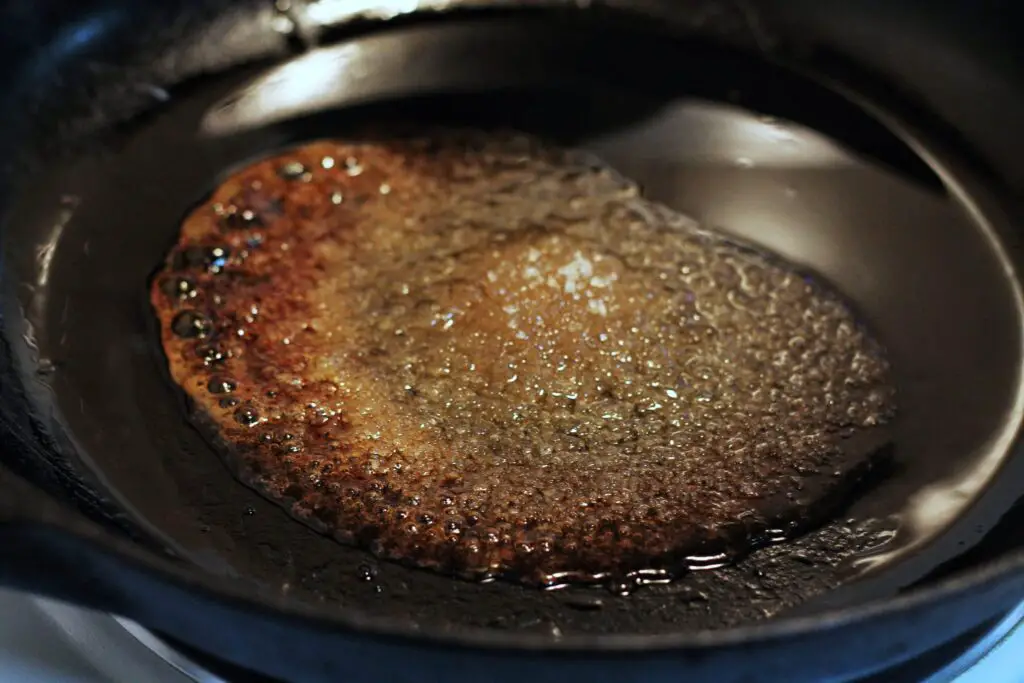
A classic European caramel is pulled at amber, roughly the colour of golden syrup. That is Stage One for a pelau cook. At this stage, the sweetness is still dominant, the bitterness has barely developed, and the flavour compounds are still relatively simple.
For pelau, you keep going. The sugar moves through amber into a deep mahogany brown. The smell shifts from purely sweet into something richer, more complex, with a depth that tells you the flavour compounds are developing the way they need to.
That slight bitterness developing in the browned sugar isn’t a mistake. It’s the counterpoint to the starch of the rice, the earthiness of the pigeon peas, the richness of the meat. The dish is built on tension between bitter, sweet, and savoury. If your sugar doesn’t carry the bitter note, the whole balance shifts. The pelau will taste rounded and pleasant and slightly flat. It will taste like something’s missing.
The difference between the right stage and taking it too far is roughly twenty seconds, depending on your heat and your pot. This is the knowledge that a recipe alone cannot give you. It lives in the body of the cook who has stood over this pot enough times to know what the right moment looks and smells like before she checks the clock.
That knowledge belongs to this culinary tradition.
How to read the sugar: a sensory guide
Since recipes often fail you here, let me be more specific than most.
Stage One: amber (roughly 30 to 40 seconds) — The sugar has melted and turned golden amber. It smells sweet. This is where most home cooks stop because it looks and smells right. It isn’t ready.
Stage Two: mahogany (60 to 75 seconds, depending on heat) — The colour has deepened considerably into a rich dark brown. The smell has shifted, less purely sweet, more rounded and slightly smokey. This is the moment to add the meat, quickly, stepping back slightly because it will spit.
Stage Three: black (beyond 90 seconds at medium-high heat) — You’ll smell it before you see it. An acrid smoke that smells like something has gone wrong, because it has. The sugar is charred, not caramelised. There’s nothing that can fix the dish at this point.
Practice with smaller quantities of sugar until Stage Two becomes familiar. Once you know what it smells like, you won’t mistake it again.
A note on the pot: a heavy-bottomed pot, cast iron or thick-gauge aluminium, distributes heat more evenly and gives you a few more seconds of control at Stage Two. A thin pot moves fast and gives you very little room. If you’ve been overshooting accidentally, the pot might be part of the reason.
What changes when you brown sugar correctly
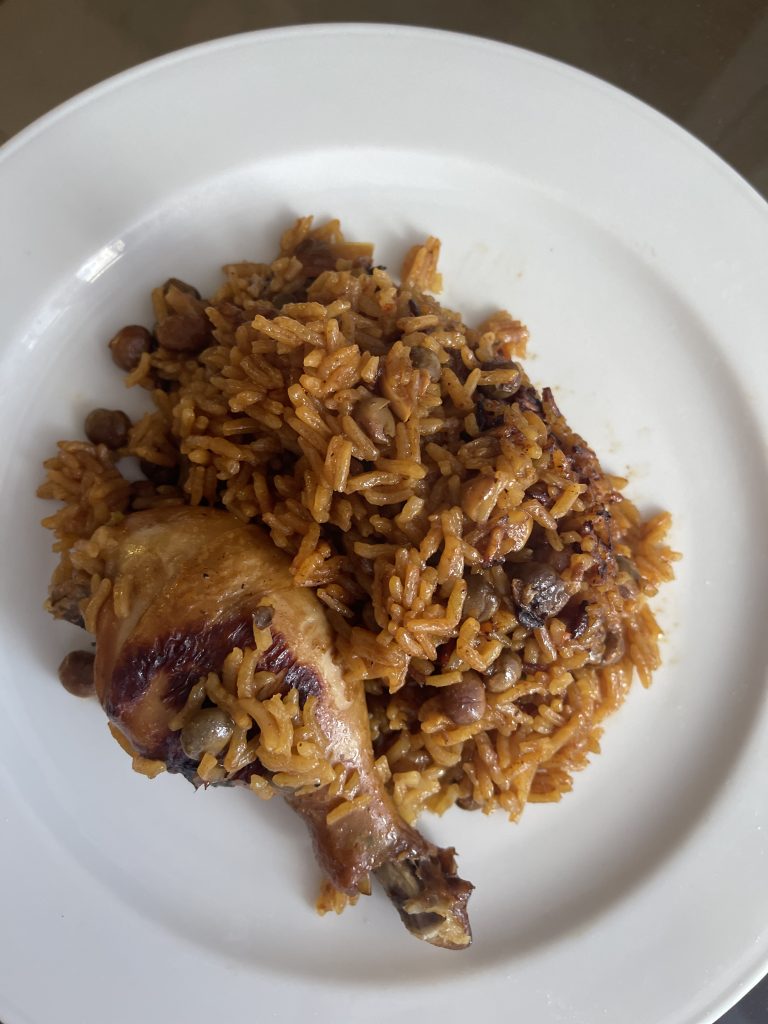
A pelau built on properly browned sugar has a deep umami quality. The rice has colour running through every grain, not just staining the outside. The meat is moist and flavourful, infused with the complexity of the liquid in the pot.
This is what your grandmother knew. She never wrote it down because she assumed everyone already knew. She learned it standing next to someone who learned it standing next to someone else. That chain of knowledge is The Croisee™ in practice. It’s also exactly what TriniGourmet exists to document and pass on.
When someone says their father’s pelau tasted different, this is almost always the reason. He knew what Stage Two looked like. He knew what it smelled like. He wasn’t guessing, and he wasn’t afraid.
The recipe isn’t the problem. It never was.
One more thing before you cook
Green seasoning quantity and marinating time matter, yes. The quality of your pigeon peas matters. What else you add to the pot, whether coconut milk, whether not, whether butter, whether none of the above, will shape the flavour from there. All of these things are real.
But none of them override the foundation. You can adjust every other variable and still make a flat pelau if the sugar wasn’t right. And if the sugar is right, the dish has a floor it can always build from, even when the other variables aren’t perfect.
Build the foundation first. Everything else follows.
If you want to go deeper into the foundational techniques of Trinidadian cooking, the kind of knowledge that lives in the Croisee™ and rarely makes it onto a recipe card, the TriniGourmet email list is where I send it. No algorithms between us, just the content.